

There is a particular kind of confidence that arrives just before the bill does. The gym membership in January. The half-read stack of business books on the shelf. The AI strategy everyone agrees is going brilliantly, right up until someone asks what it actually returned.
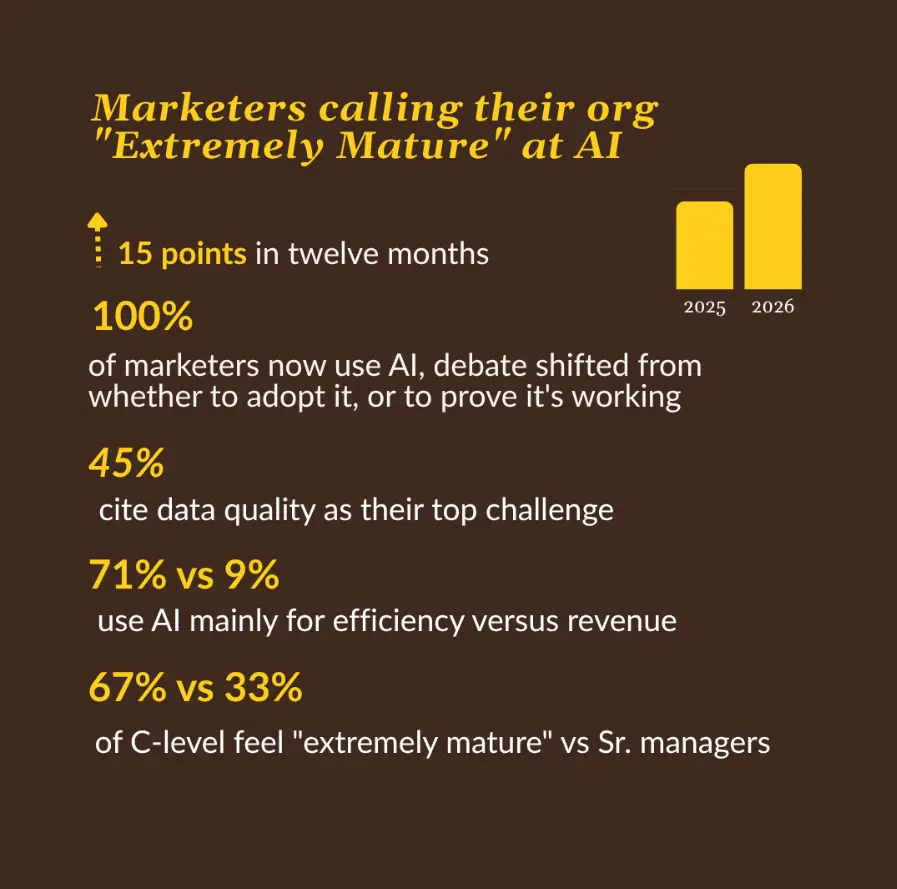
Epsilon’s 2026 benchmark study, published August 10, put numbers to that feeling. Across more than 250 marketing decision-makers in retail, consumer goods, financial services, travel and restaurants, one figure stands out. Half of marketers now rate their organisation as “extremely mature” at using AI. In 2025, only 35% said the same. Adoption has 100% of them use AI. The story has moved on to a harder question, Mature at what?
Confidence functions as a metric, though rarely organizations assume
The most common challenge these “extremely mature” marketers report is data quality. 45% believe the data feeding their AI is incomplete, inconsistent or unreliable and that is the foundation.
A model is only as good as what you feed it. An AI programme built on shaky data is not a mature programme wearing a nice suit. 71% of marketers say they mainly use AI for productivity and efficiency, doing the same work faster. Only 9% use it to generate revenue. Yet when asked how they judge whether their AI is working, 46% point to revenue gains.
Digital Maturity is what you can prove and not what you feel
This is the gap that matters, and it is why Digital Maturity has to be treated as a capability rather than a mood. The Epsilon data even shows the mood is unevenly spread. 67% of C-level marketers call their organisation “extremely mature.” Among senior managers, the people closer to the actual work, that drops to 33%. Leadership sees a finished house. The floor still sees the wiring.
For the small and mid-sized firms Essentiate Digital works with, this is oddly good news. The giants are not as far ahead as their confidence suggests. Their advantage is spend and headcount, not clarity. And clarity is the one thing you can genuinely catch up on.
Real Digital Maturity is unglamorous. It is knowing which data you trust and which you quietly ignore. It is agreeing, before you buy the tool, on what “working” looks like and how you will see it. It is leadership and the people doing the work describing the same reality. None of that shows up in a demo. All of it shows up in the results.
Where the PIE Framework comes in
This is precisely the problem Essentiate’s PIE Framework (essentiate.com/pie-framework) was built to solve. Plan, Implement, Engage, in that order, on purpose.
Most of that confident 50% skipped straight to Implement. They bought the tools, wired them into the workflow, and felt the speed. Plan is where you fix the data quality nobody wants to talk about, and decide what you are measuring and why, so that efficiency and revenue stop being mistaken for each other. Engage is where you check that the story leadership tells about AI matches the one the team lives every day, because a programme the organisation cannot agree on will never compound.
Skip Plan and you get exactly what the benchmark found which is, high confidence, shaky foundations, and a scoreboard nobody quite trusts. Digital Maturity is not the tool you installed. It is the discipline you build around it.
The uncomfortable part
Agentic AI is next, and it raises the stakes on all of this. Handing more autonomy to systems fed by unreliable data, judged by the wrong metric, and understood differently at every level of the org is not a leap forward. It is the same crack but only wider.
The firms that pull ahead over the next year will not be the ones who felt most mature in a survey. They will be the ones who did the boring Plan work first: clean inputs, honest measurement, and a shared definition of value.
*Essentiate Digital helps small and mid-sized firms turn Digital ambition into Digital Maturity they can actually defend. We diagnose first, then we build, using the PIE Framework to plan the foundation before anyone touches a tool. If your AI feels mature but you cannot yet prove it, that is exactly the conversation worth having.
Ref: https://www.epsilon.com/us/insights/resources/2026-benchmark-study-marketings-ai-inflection-point