

There is a particular kind of quiet that settles over a marketplace right before it gets loud. For small businesses, that quiet just ended.
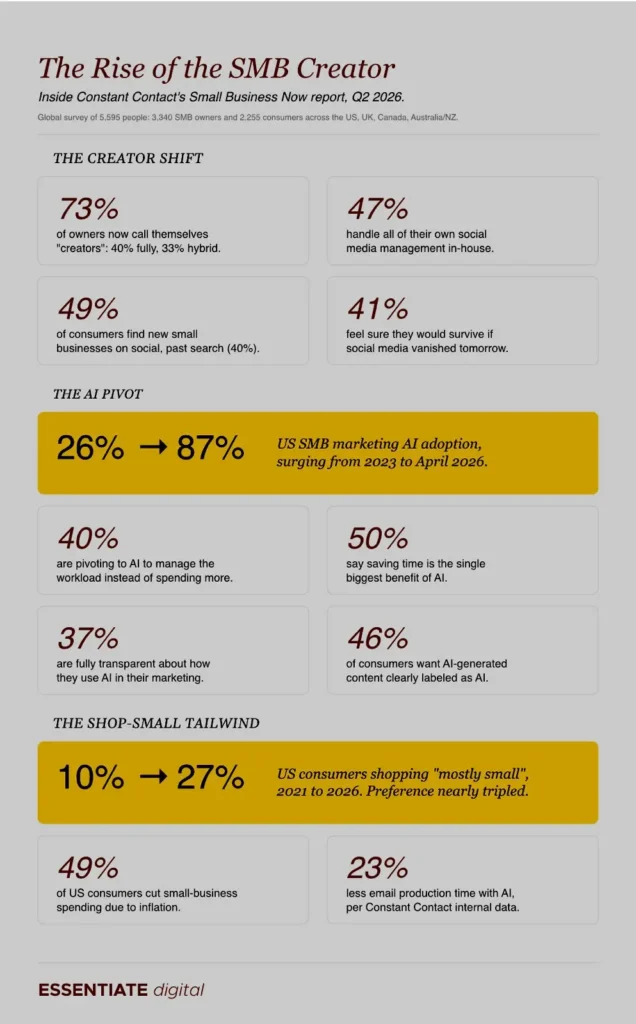
This month Constant Contact released its “Small Business Now” report, a global study of more than 5,000 small business owners and consumers. The headline reads like a cultural shift wearing a business suit: 73 percent of small business owners now describe themselves as creators. Forty percent fully, another 33 percent as owner-creator hybrids. Founders, operators, bookkeepers, and now content studios of one. Nearly half, 47 percent, run all of their own social media themselves
It is a genuinely good story. The tools that used to sit behind an agency retainer now sit on a phone. A two-person interiors studio can shoot, caption, schedule, and analyze before lunch. The barrier to looking professional has effectively dropped to zero.
Which is exactly where the interesting problem begins.
The front door is social, the rest is your home
Discovery has moved. Forty-nine percent of consumers now find new small businesses through social media, ahead of search engines at 40 percent. The feed has become the front door, and small businesses have walked through it with cameras rolling.
The report carries a quieter number worth sitting with. Only 41 percent of owners feel confident their business would survive if social media disappeared tomorrow. Read that as a warning the data is whispering: the front door belongs to someone else. Reach you rent is reach you can lose to an algorithm change you will never see coming. The businesses that sleep well are the ones turning rented attention into owned relationships, an email list, a returning customer, a reason to come back that lives on their terms.
This is the first marker of Digital Maturity treating each channel as part of one connected system rather than a string of separate performances.
AI gave everyone the same hour back
The efficiency engine behind the creator boom is artificial intelligence, and the adoption curve is steep. In the U.S., AI use in small business marketing climbed from 26 percent in 2023 to 87 percent by April 2026. One of the fastest technology curves the segment has recorded.
Notice why owners reached for it. Forty percent say they pivoted to AI specifically to manage their marketing workload instead of simply spending more, and 50 percent name saving time as the single biggest benefit. This is a sober, practical adoption. Owners are buying back hours, not chasing a trend.
Here is the catch hiding inside an 87 percent adoption rate. When the same tools meet the same templates meet the same prompt, output multiplies and starts to converge. Everyone discovers the carousel. Everyone finds the trending audio. Everyone asks the model for five punchy hooks about their new service, and the model, being the same model, obliges with the same five punchy hooks. Competence becomes universal, and competence that everyone has stops setting anyone apart.
Trust is the differentiator in hiding
The report points to where the edge is moving. Forty-six percent of consumers want businesses to clearly label AI-generated content, and 37 percent of small businesses already practice full transparency about how they use it.
That gap is an opening. As feeds fill with polished, machine-assisted sameness, the rare signal becomes a human one: a real point of view, an honest voice, a willingness to say how the work gets made. Transparency reads as confidence, and confidence is the thing a prompt cannot fake. Saved time is worth most when it funds the part of the work only a person can do.
Maturity is the moat
So producing content is now easy. Producing content that compounds is still rare. That gap is Digital Maturity, the difference between a business that posts and a business that engages with intent.
Maturity shows up in unglamorous places. A consistent voice a customer would recognize with the logo cropped out. A content rhythm tied to the buying journey rather than the posting calendar. A measure of engagement that answers to a number the owner has chosen to move. None of this arrives in an app. All of it survives the flood, because all of it runs on judgment.
The demand is real, and it rewards the distinct
The tailwind is unmistakable. In the U.S., consumer preference for shopping mostly at small businesses has nearly tripled in five years, from 10 percent in 2021 to 27 percent in 2026. People want to choose the independent shop. When they do, they cite unique products and supporting the local economy as the reasons.
The pressure is real too. Forty-nine percent of U.S. consumers say inflation has forced them to cut back spending at small businesses. So attention is available and wallets are careful. In that climate, the firms that win are the ones a customer can tell apart and trust on sight.
That is the whole game now. The “Small Business Now” numbers are an invitation and a warning in the same breath. The invitation: the cost of showing up well has collapsed, so show up. The warning: it collapsed for everyone, so showing up is no longer an achievement.
The creator wave will keep rising, Distinctiveness is what stays afloat.
Essentiate Digital brings the diagnosis before the build. We help small and mid-size firms turn scattered content into a Digital Engagement system that compounds, using the PIE framework to move from busy to mature. So, No more broken digital journeys and Your all-in-one digital engagement partner is here, Let’s talk about the system underneath your content.
Ref: https://www.prnewswire.com/news-releases/the-rise-of-the-smb-creator-how-small-businesses-are-leveraging-social-media-and-ai-to-capture-consumer-attention-302796180.html